Thai funeral flowers and wreaths: a respectful guide
A Thai funeral is usually held at a temple over several days. This guide explains the wreath tradition, what to tell the florist, and how to show respect from far away.
Updated November 2, 2026
A short note before the details
If you are reading this because someone has died, we are sorry. This guide is written to make one small task easier: showing respect to a family in Thailand when you cannot be there. It does not replace what the family, the temple or a Thai friend tells you. Where their guidance differs from ours, follow theirs.
How a Thai funeral usually runs
When someone dies, the family normally contacts a local temple (วัด, wat) to arrange the rites with monks. Ceremonies often take place at the temple, where monks lead prayers and chants. Funeral rites may last three to seven days depending on the family's wishes and means, and each evening visitors gather while monks chant. Cremation is common, in line with Buddhist ideas of impermanence.
The body is cleaned and dressed, then placed in a coffin. The family receives guests over the days of the rites. Visitors usually come in the evening, sit quietly, listen to the chanting and offer condolences. A final ceremony, the cremation, closes the sequence. At that ceremony, guests may be handed a sandalwood flower, ดอกไม้จันทน์ (dok mai chan), to place near the coffin or on a prepared tray.
Because dates depend on the family, you cannot work out the schedule from a calendar. Ask the family, a friend or the temple office. If the date is not yet known, wait until you have it. Do not guess.
The wreath: พวงหรีด (puang reed)
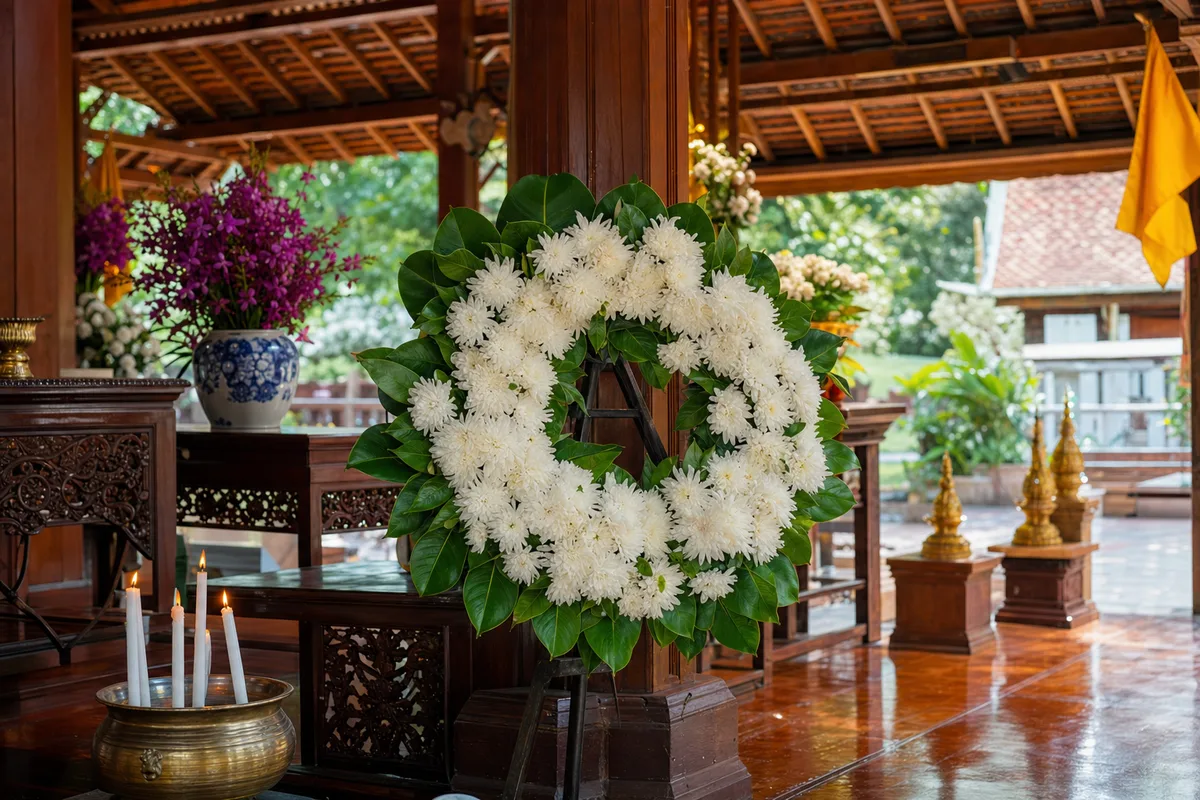
The standard way to send condolences is a wreath, พวงหรีด (puang reed). The word หรีด is the Thai spelling of the English word wreath. Wreaths are associated with funerals in Thailand as a sign of condolence, and the custom is described as coming from Western practice, introduced in the reign of King Rama IV.
In practice, Thais often ask a florist to make the wreath. The florist builds it with a message and delivers it to the funeral. The same is possible from abroad: you give the details, and the florist handles the work on site. You will not need to bring anything yourself.
Where it goes matters. One guide to flower customs says wreaths belong at the temple, not at the home. Send it to the place where the rites are held, not to the family's house, and ask the family which hall or building is correct. The name of the deceased on the wreath is what tells the people receiving it where it belongs.
What to tell the florist
Treat the order like an address with a name on it. These are the details to collect before you ask for a wreath.
- The full name of the deceased, spelled in Thai if you can get it. Ask a family member to write it out.
- The name of the temple, its district and, if known, the hall or building where the rites are held.
- The date and day of the rites, as given by the family.
- The sender's name, exactly as you wish it to appear. A company name, a family name or a group of friends are all possible.
- A short message of condolence. Brevity is respectful.
- A contact number for the florist to confirm the details, written in the +66 form described in the ordering guide.
Ask the florist what the wreath will look like before you confirm, and whether the message and the sender's name will be shown. Do not assume. Make sure the name of the deceased and of the sender are spelled correctly, because a wreath is a public message that many people will read.
Colours and flowers
The sources agree that white flowers and a simple wreath are appropriate. They also advise caution with large, lavish arrangements: ask the family first. If you are not sure, choose plain over elaborate.
Some flowers carry funeral meanings that you may not expect. One guide notes that tuberose is the flower Thais usually place near the coffin at funerals, which is why it is kept away from hospital rooms. If you are sending a living bouquet for another occasion, read the flower etiquette guide so that the same flower does not appear in the wrong setting.
If you attend in person
Guides for foreign visitors give the same basic advice.
- Dress: black, dark grey, navy or another muted colour. Some families accept modest white. Avoid red, bright colours, loud prints, shorts and tank tops.
- Behaviour: sit quietly, silence your phone and watch the family before standing, bowing or joining any ritual.
- Monks: do not touch monks, their robes or ritual items. Women in particular should take care, because physical contact with monks is restricted in Thai Buddhist practice.
- Cash: a plain white envelope with a modest donation is a common gift. You can give it to a family member or put it in a collection box. There is no universal amount.
Photographs are best left alone unless a family member invites you. Keep your voice low, and leave when the family signals the evening is over.
What to write, and when to write it
A short, sincere line is enough. In English, With deepest sympathy, from the Miller family will be understood. In Thai, the phrase ขอแสดงความเสียใจ (khor sa-daeng khwam sia jai) is the standard way to express condolences. Because spelling and tone matter, ask a Thai friend of the family to check anything beyond that single phrase. The card guide gathers a few more.
If you cannot send a wreath, a call or message to the family still counts. A kind note, sent in good time, is worth more than a late arrangement. If you want help with the practical side of an order, the contact page is the place to start.
Common questions
Do I send the wreath to the family's home or to the temple?
To the temple or the place where the ceremony is held. One guide on Thai flower customs says wreaths should go to temples, never to homes. Get the name of the temple and, if there is one, the hall or sala where the rites take place, from the family or a friend.
Are white flowers the right choice?
White flowers or a simple wreath are described as appropriate at Thai funerals. The same source advises asking before bringing a large arrangement. Plain and modest is safer than showy. Our etiquette guide explains why some other flowers carry funeral meanings.
What do I put on the message?
Keep it short. Your name and, if relevant, your relationship to the family are the key parts, with a few words of condolence. If you are not sure of Thai phrasing, use English and ask a Thai friend of the family to check it. Examples are in the card guide.
Can I attend if I am not Buddhist?
Guides for foreign visitors say you can. Dress in muted colours, stay quiet, silence your phone and follow what the family does. If you are unsure about a ritual, watch first and ask afterwards.
Ready to send?
A local florist arranges the bouquet and delivers it to the address you give.
See bouquets